

If you were injured in a car accident or another type of personal injury accident, identifying the party at fault is crucial to securing compensation for your injuries. In some cases, negligence (fault) is clear, but in other situations, determining who was at fault is not as straightforward. In fact, insurance companies frequently argue that an injured victim caused or contributed to an accident as a way to reduce or eliminate their insured’s liability. In 2023, Florida enacted a modified comparative negligence law that may directly affect your financial recovery if your own negligence contributed to a personal injury accident in which you suffered injuries. On an episode of Lawyer Podcast, attorney Paul Reed explains how Florida’s modified comparative negligence law operates and why you need an experienced personal injury attorney to prevent the insurance company from using the law against you.
What Is Comparative Negligence?
Listen to Paul and Jason discuss this case on the LiveFeedReed podcast
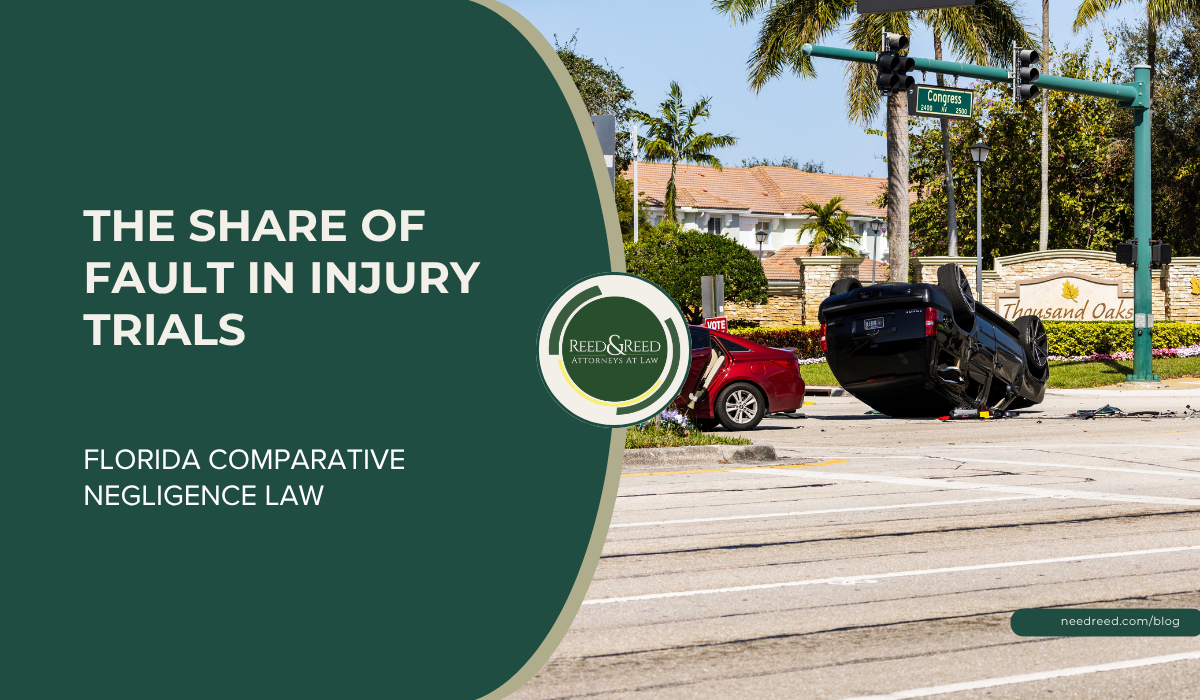
Whether it is a car accident, a slip and fall injury, or a premises liability accident, it is not uncommon for more than one party to share responsibility for the resulting injuries. For example, in a car crash, one driver might be speeding while a second driver is distracted by a text message at the time of the collision. In that case, the negligent conduct of both drivers may arguably have contributed to the crash. Comparative negligence is a legal principle that allows legal liability for an accident to be divided among the parties whose negligent conduct contributed to the resulting injuries. State law dictates whether comparative negligence is utilized when more than one party was negligent and, if so, whether pure comparative or modified negligence applies.
What Is Florida’s Modified Comparative Negligence Law?
When more than one party shares responsibility for an accident, the law must decide how to address that shared responsibility when a party seeks to recover compensation for their injuries. A handful of states rely on contributory negligence, which prevents an injured victim from recovering any compensation if they share any of the fault. In other words, if you were one percent responsible, you cannot receive any compensation.
Fortunately, most states now use some version of comparative negligence. Pure comparative negligence allows an injured victim to recover compensation regardless of their share of fault with their compensation reduced in proportion to their negligence. By way of illustration, if you have $100,000 in damages in a car accident, but you were found to be 60 percent at fault, you would potentially be entitled to recover 40 percent, or $40,000 in damages.
Modified comparative negligence also apportions fault and reduces compensation accordingly, but it establishes a negligence threshold that you cannot exceed and still recover compensation. Florida’s modified comparative negligence law only allows you to recover damages if your share of the fault is 50 percent or less. Put another way, if you are found to be 51 percent or more at fault, you are barred from recovering anything in a personal injury accident claim. If you are entitled to recover under Florida’s law, your compensation will be reduced by your share of the fault. For instance, if you suffered $100,000 in damages and were found to be 25 percent at fault, you would receive 75 percent, or $75,000 in compensation.
Why Insurance Companies Try to Shift Blame onto Injured Victims
Insurance companies routinely attempt to use Florida’s modified comparative negligence law to their advantage when investigating and negotiating claims. Claiming that an injured victim’s own negligence contributed to the resulting injuries provides the insurance company with a way to reduce or even eliminate their insured’s liability. In the example above where the victim suffered $100,000 in damages, every percentage of negligence the insurance company can shift onto the victim saves them $1,000. Moreover, if they can shift 51 percent of the negligence onto the injured victim, they can avoid liability altogether. Insurance companies have absolutely nothing to lose and everything to gain by making a comparative negligence argument in a personal injury case.
How to Protect Yourself in a Florida Personal Injury Accident
In the minutes, hours, and even days following a car crash or other personal injury accident, you may not be thinking about legal doctrines and the allocation of negligence, but you can rest assured that the insurance adjuster that contacts you will be. For that reason, it is imperative that you take steps to protect your right to a full and fair recovery from your injuries, such as:
- Seek medical treatment. Because some serious injuries do not exhibit symptoms immediately, always seek a thorough medical examination as soon as possible.
- Document the accident. Take photos or videos, obtain contact information for witnesses, and check for doorbell or dashcam videos that show what actually happened.
- Do not speak to the insurance company. An insurance adjuster may call you shortly after the accident. Even a polite and genuine response to a question such as “I feel so bad for the other person” can be misconstrued as an admission of fault on your part. To prevent that from happening, avoid talking to anyone about the accident.
- Stay off social media. Likewise, refrain from posting about the accident or your injuries. A seemingly harmless comment on social media could be used against you by the insurance company.
- Consult with an attorney. Consult with an experienced personal injury attorney as soon as possible. Your attorney understands the modified comparative negligence law and will aggressively work to prevent the law from being used to reduce or eliminate the compensation to which you are entitled.
Do You Have Questions about the Florida Modified Comparative Negligence Law?
If you have additional questions about how the Florida modified comparative negligence law could impact your right to compensation for injuries sustained in a personal injury accident, schedule a free initial consultation with the experienced personal injury attorneys at Reed & Reed.